🧾 AK Sir Notes Series
STATE BANK OF INDIA (SBI): HISTORY, FACTS & LATEST ISSUES
🔹 1. Introduction
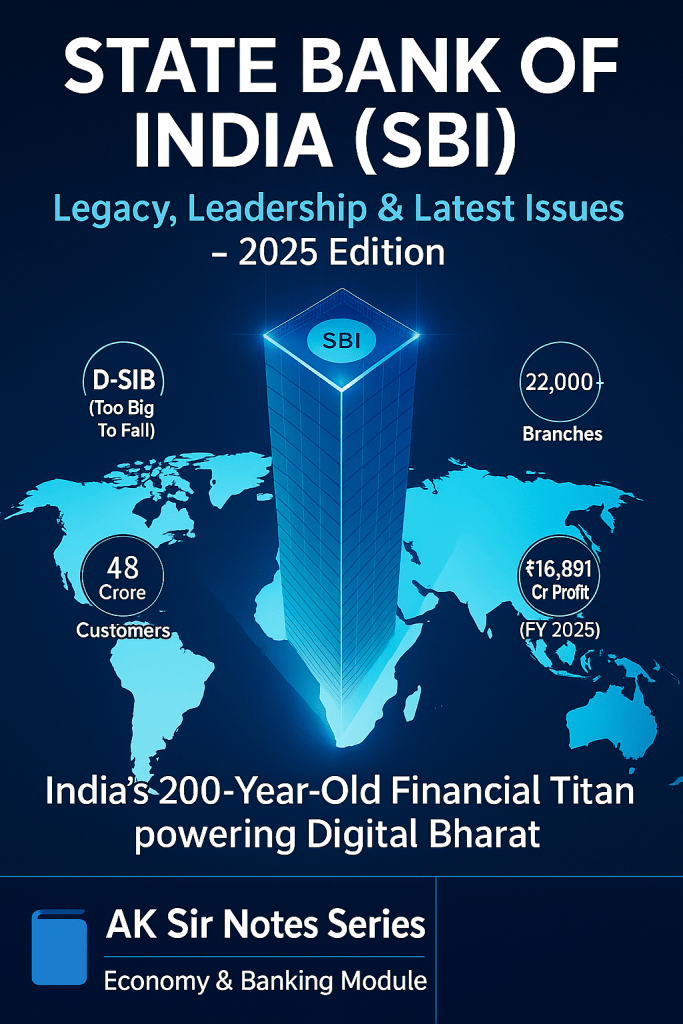
- SBI is India’s largest public sector commercial bank, representing the backbone of the nation’s financial system.
- It combines 200+ years of legacy with a modern, digital-first approach.
- Plays a major role in financial inclusion, government schemes, and economic stability.
🔹 2. Historical Evolution
Year Event 1806 Bank of Calcutta established (later Bank of Bengal) 1840 & 1843 Bank of Bombay & Bank of Madras formed 1921 Three Presidency Banks merged → Imperial Bank of India1955 Imperial Bank nationalized → State Bank of India created under SBI Act 1959 SBI (Subsidiary Banks) Act passed – created associate banks 2017 All associates merged with SBI → one unified national bank
🔹 3. Present Profile
- Headquarters: Mumbai
- Ownership: Government of India (via RBI & Ministry of Finance)
- Employees: ~2.5 lakh (2025)
- Customers: ~48 crore
- Branches: 22,000+ (including 229 foreign offices)
- Market Share: ~25% deposits & 20% loans
- Classification: D-SIB (Domestic Systemically Important Bank) — “Too Big to Fail”
🔹 4. Key Subsidiaries
- SBI Life Insurance
- SBI Mutual Fund
- SBI Cards & Payment Services
- SBI General Insurance
- SBI Capital Markets
(All expected to be listed or expanded further for capital unlocking.)
🔹 5. Recent Financial Performance (FY 2024-25)
- Net Profit: ₹16,891 crore (up > 80% YoY)
- Gross NPA: 2.07 % (improved from 2.47 %)
- Loan Growth: 14 %
- Deposit Growth: 9.7 %
- Capital Raise: ₹20,000 crore bonds approved for FY 2026
🟢 Strong financials, improved asset quality, and expanding retail + corporate lending base.
(a) Tech Disruptions
🔹 6. Latest Issues & Developments

- April & July 2025: Nationwide outages in YONO / Net Banking / NEFT / IMPS.
- Challenge: Strengthening digital infrastructure & cyber resilience.
(b) Compliance Risks
- SBI stopped forex transactions for Nayara Energy (Russia-linked) → avoiding sanctions.
- Reflects rising geopolitical & compliance sensitivity.
(c) Interest Rate Cuts
- June 2025: Savings rate 2.5 % (record low), FD rates cut by 25 bps.
- Aim: Manage margins amid global monetary tightening.
(d) Strategic Expansion
- Joined India International Bullion Exchange (IIBX) — 1st PSU bank to trade bullion.
- Focus on transparency, diversification, and international reach.
(e) Capital Adequacy
- RBI retained SBI as D-SIB with higher capital buffer (0.8 % surcharge).
- Still lower CET-1 ratio (≈ 10.8 %) than private peers (14–16 %).
🔹 7. SWOT Analysis
StrengthsWeaknesses Long legacy & public trust Bureaucratic structure Largest branch network Tech outages & slow innovation Government backing Lower capital adequacy Strong subsidiaries Heavy policy dependence OpportunitiesThreats Digital & AI transformation Private bank competition Listing of subsidiaries Cybersecurity risks Rural & MSME lending Global regulatory pressures
🔹 8. Socio-Economic Role
- Implements Jan Dhan Yojana, DBT transfers, Mudra loans, etc.
- Major player in rural banking & financial inclusion.
- Symbol of trust, employment, and social equity in India’s financial landscape.
🔹 9. Key Current Affairs Points (2025)
- RBI retains SBI in “Too Big to Fail” list.
- Record quarterly profit of ₹16,891 crore (Q3 FY 2025).
- ₹20,000 crore bond issue approved.
- Interest rate cuts → lowest ever 2.5 %.
- Frequent YONO outages → customer backlash.
- Joined IIBX → first PSU bank in bullion trade.
- Suspended forex with Nayara Energy → sanctions risk.
🔹 10. Conclusion
SBI stands at a strategic crossroads — balancing public welfare with corporate efficiency.
Its future depends on:
1️⃣ Robust digital infrastructure
2️⃣ Capital strength & governance reforms
3️⃣ Technological innovation and global compliance
💬 In essence: SBI remains the financial heartbeat of India — a bridge between social banking and modern finance.
✍️ Prepared by: AK Sir
AK Sir Notes Series | Economy & Banking Module
Amaresh Yadav 🇮🇳


Leave a comment