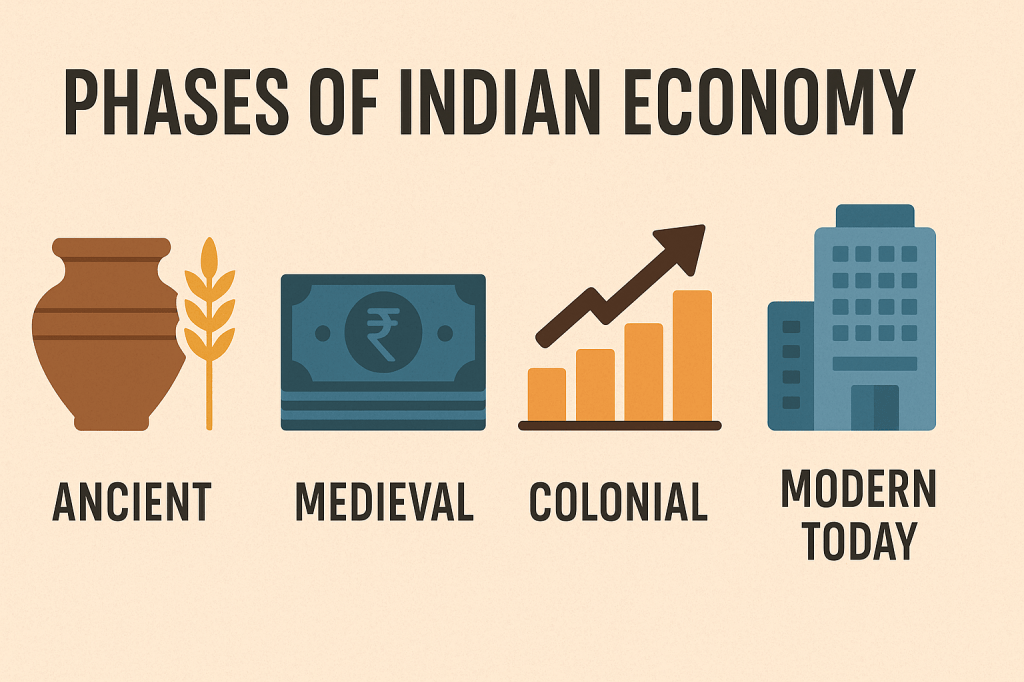
The Evolution of Indian Economy: An Economist’s Perspective
Introduction
The Indian economy is one of the world’s oldest and most resilient systems. From the flourishing trade networks of the Indus Valley to its emergence as the world’s fifth-largest economy today, India’s economic journey reflects both continuity and transformation. Economists have long studied this trajectory — highlighting phases of prosperity, decline under colonial exploitation, and revival through planned development and liberalisation. Understanding these phases is essential to appreciate the structural strengths and persistent challenges of the Indian economy.
Phase 1: Ancient Economy (up to 1200 CE)
Economists often describe ancient India as an example of agrarian prosperity coupled with global integration. Agriculture formed the backbone, supported by advanced irrigation systems, iron tools, and surplus production. Villages were largely self-sufficient units, yet connected through vibrant internal trade.
Crafts and industries flourished — textiles like the Muslin of Dhaka and silks of the Deccan commanded global demand. The discovery of Roman gold coins in South India illustrates India’s favourable balance of trade, a fact lamented by Roman historian Pliny as Rome’s “drain of gold to India.” Guilds (Shreni) functioned as early chambers of commerce, regulating production and quality.
Economic historian Angus Maddison estimated that around the 1st century CE, India contributed nearly one-third of world GDP, reflecting its pre-eminent status in the global economy.
Phase 2: Medieval Economy (1200–1700 CE)
With the Delhi Sultanate and later the Mughals, the economy remained agrarian, but also achieved unprecedented excellence in textiles and handicrafts. The Ain-i-Akbari, written by Abul Fazl, provides a systematic account of agriculture, revenue, and prices under Akbar, evidence of a sophisticated economic administration.
Ports such as Surat, Masulipatnam, and Calicut linked India to Persia, Arabia, and Europe. India’s textiles — cotton, silk, and Kashmiri shawls — dominated global markets. By the 17th century, Mughal India accounted for around 25% of the world’s GDP, rivaling the prosperity of contemporary Europe.
Yet, economists note the dependence on heavy land revenue and the vulnerability of peasants. The prosperity of Mughal India coexisted with agrarian exploitation, which later became a point of entry for European trading companies.

Phase 3: Colonial Economy (1757–1947)
The colonial period marked the most drastic transformation. Economists such as Dadabhai Naoroji highlighted the “Drain of Wealth”, where India’s surplus was systematically transferred to Britain through trade surpluses, salaries of officials, and interest payments.
The process of deindustrialisation destroyed India’s traditional handicrafts. Hand-spun textiles were replaced by cheap machine-made imports from Britain, rendering artisans jobless. Agriculture was commercialised to serve imperial interests — peasants were forced into cash crops like indigo, jute, and cotton. Famines became frequent, culminating in the Bengal famine of 1943.
Despite the introduction of railways and telegraphs, these were primarily designed to facilitate colonial exploitation rather than development. By independence, India’s share in world GDP had fallen below 4%, life expectancy was barely 32 years, and literacy stood at just 12%.
Phase 4: Post-Independence Economy (1947–1991)
At independence, India inherited a stagnant, underdeveloped economy. The state adopted a strategy of planned development under the guidance of the Planning Commission (1950). Influenced by Nehru and economist P.C. Mahalanobis, India chose a mixed economy model — combining a dominant public sector with regulated private enterprise.
The First Five-Year Plan (1951–56) prioritised agriculture, while the Second Plan (1956–61) emphasised heavy industries. Public Sector Undertakings such as LIC, ONGC, and BHEL became symbols of India’s industrial base. The Green Revolution of the 1960s, guided by M.S. Swaminathan, achieved food self-sufficiency.
However, economic growth averaged only 3.5% per year, a phenomenon economist Raj Krishna famously termed the “Hindu Rate of Growth.” Excessive regulations — the “License-Permit-Quota Raj” — stifled innovation, and by the late 1980s, fiscal and balance-of-payments crises emerged.
Phase 5: Liberalisation Era (1991–2014)
The 1991 crisis, when India had only two weeks of foreign reserves and was forced to mortgage gold to the IMF, became the turning point. Under Prime Minister P.V. Narasimha Rao and Finance Minister Dr. Manmohan Singh, the New Economic Policy of 1991 introduced sweeping reforms:
- Liberalisation → removal of licensing, deregulation.
- Privatisation → disinvestment in PSUs, private entry in core sectors.
- Globalisation → opening up to foreign investment and trade.
The results were transformative. The IT and services sector expanded rapidly, with companies like Infosys and TCS putting India on the global map. GDP growth rose to 6–8%, and India became a trillion-dollar economy by 2007.
Yet, economists point out limitations: agriculture lagged, employment generation was slow, and inequality widened. The benefits of reforms were concentrated in urban areas, leaving rural India behind.
Phase 6: Contemporary Economy (2014–Today)
Since 2014, India’s economy has undergone new reforms and challenges. Key initiatives include Make in India, Digital India, Startup India, Skill India, and Atmanirbhar Bharat. Structural reforms such as GST (2017), Insolvency and Bankruptcy Code (2016), and labour law codification aimed at simplifying the economy.
India’s digital infrastructure has become a model for the world — UPI launched in 2016 now handles the highest volume of real-time transactions globally. India has also emerged as a global hub of startups, crossing 100 unicorns.
The COVID-19 pandemic (2020) caused the sharpest GDP contraction since independence (–7.3% in 2020–21), exposing vulnerabilities such as unemployment and migrant worker crises. Recovery has been uneven but resilient.
By 2022, India overtook the UK to become the fifth largest economy. Economists note the twin realities: on one hand, a fast-growing digital and services economy; on the other, persistent structural challenges like agrarian distress, unemployment, and rising inequality.
Conclusion
From being the world’s economic powerhouse in ancient times, to colonial exploitation, to post-independence planned development and the liberalisation reforms of 1991, India’s economy has displayed both continuity and disruption.
Economists like Angus Maddison remind us of India’s historical wealth, while Dadabhai Naoroji highlights the devastating colonial drain. Raj Krishna’s “Hindu Rate of Growth” reflects the limitations of state-led planning, while the 1991 reforms underscore the transformative power of markets.
Today, India stands at a crossroads — a digital leader and global growth engine, yet grappling with deep-rooted challenges of employment, inequality, and sustainability. The path ahead, economists argue, must ensure inclusive, equitable, and environmentally sustainable growth if India is to reclaim its historical stature as an economic powerhouse.



Leave a comment